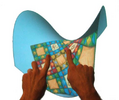
The creation of most models used in computer animation and computer games requires the assignment of texture coordinates, texture painting, and texture editing. We present a novel approach for texture placement and editing based on direct manipulation of textures on the surface. Compared to conventional tools for surface texturing, our system combines UV-coordinate specification and texture editing into one seamless process, reducing the need for careful initial design of parameterization and providing a natural interface for working with textures directly on 3D surfaces.A combination of efficient techniques for interactive constrained parameterization and advanced input devices makes it possible to realize a set of natural interaction paradigms. The texture is regarded as a piece of stretchable material, which the user can position and deform on the surface, selecting arbitrary sets of constraints and mapping texture points to the surface; in addition, the multi-touch input makes it possible to specify natural handles for texture manipulation using point constraints associated with different fingers. Pressure can be used as a direct interface for texture combination operations. The 3D position of the object and its texture can be manipulated simultaneously using two-hand input.

We present the Haptic Shading Framework (HSF), a framework for procedurally defining haptic texture. HSF haptic texture shaders are short procedures allowing an application-programmer to easily define interesting haptic surface interaction and the parameters that control the surface properties. These shaders provide the illusion of surface characteristics by altering previously calculated forces from object collision in the haptic pipeline.HSF can be used in an existing haptic application with few modifications. The framework consists of user-programmable modules that are dynamically loaded. This framework and all user-defined procedures are written in C++, with a provided library of useful math and geometry functions. These functions are meant to mimic RenderMan functionality, creating a familiar shading environment. As we demonstrate, many procedural shading methods and algorithms can be directly adopted for haptic shading.