Keywords
UIST2.0 Archive - 20 years of UIST
Back
Back to keywords index

graph

graph drawing

In Proceedings of UIST 1997
Article Picture

An interactive constraint-based system for drawing graphs (p. 97-104)

graph layout

In Proceedings of UIST 1994
Article Picture

Evolutionary learning of graph layout constraints from examples (p. 103-108)

Abstract plus

We propose a new evolutionary method of extracting user preferences from examples shown to an automatic graph layout system. Using stochastic methods such as simulated annealing and genetic algorithms, automatic layout systems can find a good layout using an evaluation function which can calculate how good a given layout is. However, the evaluation function is usually not known beforehand, and it might vary from user to user. In our system, users show the system several pairs of good and bad layout examples, and the system infers the evaluation function from the examples using genetic programming technique. After the evaluation function evolves to reflect the preferences of the user, it is used as a general evaluation function for laying out graphs. The same technique can be used for a wide range of adaptive user interface systems.

In Proceedings of UIST 2001
Article Picture

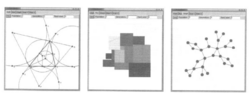
A modular geometric constraint solver for user interface applications (p. 91-100)

Abstract plus

Constraints have been playing an important role in the user interface field since its infancy. A prime use of constraints in this field is to automatically maintain geometric layouts of graphical objects. To facilitate the construction of constraint-based user interface applications, researchers have proposed various constraint satisfaction methods and constraint solvers. Most previous research has focused on either local propagation or linear constraints, excluding more general nonlinear ones. However, nonlinear geometric constraints are practically useful to various user interfaces, e.g., drawing editors and information visualization systems. In this paper, we propose a novel constraint solver called Chorus, which realizes various powerful nonlinear geometric constraints such as Euclidean geometric, non-overlapping, and graph layout constraints. A key feature of Chorus is its module mechanism that allows users to define new kinds of geometric constraints. Also, Chorus supports "soft" constraints with hierarchical strengths or preferences (i.e., constraint hierarchies). We describe its framework, algorithm, implementation, and experimental results.