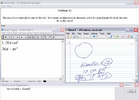
EdgeWrite is a new unistroke text entry method for handheld devices designed to provide high accuracy and stability of motion for people with motor impairments. It is also effective for able-bodied people. An EdgeWrite user enters text by traversing the edges and diagonals of a square hole imposed over the usual text input area. Gesture recognition is accomplished not through pattern recognition but through the sequence of corners that are hit. This means that the full stroke path is unimportant and recognition is highly deterministic, enabling better accuracy than other gestural alphabets such as Graffiti. A study of able-bodied users showed subjects with no prior experience were 18% more accurate during text entry with Edge Write than with Graffiti (p>.05), with no significant difference in speed. A study of 4 subjects with motor impairments revealed that some of them were unable to do Graffiti, but all of them could do Edge Write. Those who could do both methods had dramatically better accuracy with Edge Write.

As technical as we have become, modern computing has not permeated many important areas of our lives, including mathematics education which still involves pencil and paper. In the present study, twenty high school geometry students varying in ability from low to high participated in a comparative assessment of math problem solving using existing pencil and paper work practice (PP), and three different interfaces: an Anoto-based digital stylus and paper interface (DP), pen tablet interface (PT), and graphical tablet interface (GT). Cognitive Load Theory correctly predicted that as interfaces departed more from familiar work practice (GT > PT > DP), students would experience greater cognitive load such that performance would deteriorate in speed, attentional focus, meta-cognitive control, correctness of problem solutions, and memory. In addition, low-performing students experienced elevated cognitive load, with the more challenging interfaces (GT, PT) disrupting their performance disproportionately more than higher performers. The present results indicate that Cognitive Load Theory provides a coherent and powerful basis for predicting the rank ordering of users' performance by type of interface. In the future, new interfaces for areas like education and mobile computing could benefit from designs that minimize users' load so performance is more adequately supported.

Computing devices within current work and play environments are relatively static. As the number of 'networked' devices grows, and as people and their devices become more dynamic, situations will commonly arise where users will wish to use 'that device there' instead of navigating through traditional user interface widgets such as lists. This paper describes a process for identifying devices through a pointing gesture using custom tags and a custom stylus called the gesturePen. Implementation details for this system are provided along with qualitative and quantitative results from a formal user study. As ubiquitous computing environments become more pervasive, people will rapidly switch their focus between many computing devices. The results of our work demonstrate that our gesturePen method can improve the user experience in ubiquitous environments by facilitating significantly faster interactions between computing devices.

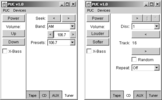
The personal universal controller (PUC) is an approach for improving the interfaces to complex appliances by introducing an intermediary graphical or speech interface. A PUC engages in two-way communication with everyday appliances, first downloading a specification of the appliance's functions, and then automatically creating an interface for controlling that appliance. The specification of each appliance includes a high-level description of every function, a hierarchical grouping of those functions, and dependency information, which relates the availability of each function to the appliance's state. Dependency information makes it easier for designers to create specifications and helps the automatic interface generators produce a higher quality result. We describe the architecture that supports the PUC, and the interface generators that use our specification language to build high-quality graphical and speech interfaces.

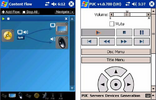
Systems of connected appliances, such as home theaters and presentation rooms, are becoming commonplace in our homes and workplaces. These systems are often difficult to use, in part because users must determine how to split the tasks they wish to perform into sub-tasks for each appliance and then find the particular functions of each appliance to complete their sub-tasks. This paper describes Huddle, a new system that automatically generates task-based interfaces for a system of multiple appliances based on models of the content flow within the multi-appliance system.

The proliferation of wireless handheld devices is placing the World Wide Web in the palms of users, but this convenience comes at a high interactive cost. The Web that came of age on the desktop is ill-suited for use on the small displays of handhelds. Today, handheld browsing often feels like browsing on a PC with a shrunken desktop. Overreliance on scrolling is a big problem in current handheld browsing. Users confined to viewing a small portion of each page often lack a sense of the overall context --- they may feel lost in a large page and be forced to remember the locations of items as those items scroll out of view. In this paper, we present a synthesis of interaction techniques to address these problems. We implemented these techniques in a prototype, WebThumb, that can browse the live Web.

The recent trend towards miniaturization of projection technology indicates that handheld devices will soon have the ability to project information onto any surface, thus enabling interfaces that are not possible with current handhelds. We explore the design space of dynamically defining and interacting with multiple virtual information spaces embedded in a physical environment using a handheld projector and a passive pen tracked in 3D. We develop techniques for defining and interacting with these spaces, and explore usage scenarios.

Recent research on handheld projector interaction has expanded the display and interaction space of handheld devices by projecting information onto the physical environment around the user, but has mainly focused on single-user scenarios. We extend this prior single-user research to co-located multi-user interaction using multiple handheld projectors. We present a set of interaction techniques for supporting co-located collaboration with multiple handheld projectors, and discuss application scenarios enabled by them.

Designing interfaces for interactive handheld projectors is an exiting new area of research that is currently limited by two problems: hand jitter resulting in poor input control, and possible reduction of image resolution due to the needs of image stabilization and warping algorithms. We present the design and evaluation of a new interaction technique, called zoom-and-pick, that addresses both problems by allowing the user to fluidly zoom in on areas of interest and make accurate target selections. Subtle design features of zoom-and-pick enable pixel-accurate pointing, which is not possible in most freehand interaction techniques. Our evaluation results indicate that zoom-and-pick is significantly more accurate than the standard pointing technique described in our previous work.