Keywords
UIST2.0 Archive - 20 years of UIST
Back
Back to keywords index

asynchronous

asynchronous

In Proceedings of UIST 1997
Article Picture

Supporting cooperative and personal surfing with a desktop assistant (p. 129-138)

asynchronous interaction

In Proceedings of UIST 1997
Article Picture

Designing and implementing asynchronous collaborative applications with Bayou (p. 119-128)

asynchronous message passing

In Proceedings of UIST 1992
Article Picture

Tools for building asynchronous servers to support speech and audio applications (p. 71-78)

Abstract plus

Distributed client/server models are becoming increasingly prevalent in multimedia systems and advanced user interface design. A multimedia application, for example, may play and record audio, use speech recognition input, and use a window system for graphical I/O. The software architecture of such a system can be simplified if the application communicates to multiple servers (e.g., audio servers, recognition servers) that each manage different types of input and output. This paper describes tools for rapidly prototyping distributed asynchronous servers and applications, with an emphasis on supporting highly interactive user interfaces, temporal media, and multi-modal I/O.

The Socket Manager handles low-level connection management and device I/O by supporting a callback mechanism for connection initiation, shutdown, and for reading incoming data. The Byte Stream Manager consists of an RPC compiler and run-time library that supports synchronous and asynchronous calls, with both a programmatic interface and a telnet interface that allows the server to act as a command interpreter. This paper details the tools developed for building asynchronous servers, several audio and speech servers built using these tools, and applications that exploit the features provided by the servers.

asynchronous user interface

In Proceedings of UIST 2002
Article Picture

User interfaces when and where they are needed: an infrastructure for recombinant computing (p. 171-180)

Abstract plus

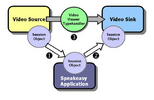
Users in ubiquitous computing environments need to be able to make serendipitous use of resources that they did not anticipate and of which they have no prior knowledge. The Speakeasy recombinant computing framework is designed to support such ad hoc use of resources on a network. In addition to other facilities, the framework provides an infrastructure through which device and service user interfaces can be made available to users on multiple platforms. The framework enables UIs to be provided for connections involving multiple entities, allows these UIs to be delivered asynchronously, and allows them to be injected by any party participating in a connection.

distributed asynchronous algorithm

In Proceedings of UIST 1995
Article Picture

Supporting distributed, concurrent, one-way constraints in user interface applications (p. 121-132)