Keywords
UIST2.0 Archive - 20 years of UIST
Back
Back to keywords index

architecture

client-server architecture

In Proceedings of UIST 1994
Article Picture

ENO: synthesizing structured sound spaces (p. 49-57)

Abstract plus

ENO is an audio server designed to make it easy for applications in the Unix environment to incorporate non-speech audio cues. At the physical level, ENO manages a shared resource, namely the audio hardware. At the logical level, it manages a sound space that is shared by various client applications. Instead of dealing with sound in terms of its physical description (i.e., sampled sounds), ENO allows sounds to be presented and controlled in terms of higher-level descriptions of sources, interactions, attributes, and sound space. Using this structure, ENO can facilitate the creation of consistent, rich systems of audio cues. In this paper, we discuss the justification, design, and implementation of ENO.

component architecture

In Proceedings of UIST 1997
Article Picture

Simplifying component development in an integrated groupware environment (p. 65-72)

distributed client-server architecture

In Proceedings of UIST 1992
Article Picture

Tools for building asynchronous servers to support speech and audio applications (p. 71-78)

Abstract plus

Distributed client/server models are becoming increasingly prevalent in multimedia systems and advanced user interface design. A multimedia application, for example, may play and record audio, use speech recognition input, and use a window system for graphical I/O. The software architecture of such a system can be simplified if the application communicates to multiple servers (e.g., audio servers, recognition servers) that each manage different types of input and output. This paper describes tools for rapidly prototyping distributed asynchronous servers and applications, with an emphasis on supporting highly interactive user interfaces, temporal media, and multi-modal I/O.

The Socket Manager handles low-level connection management and device I/O by supporting a callback mechanism for connection initiation, shutdown, and for reading incoming data. The Byte Stream Manager consists of an RPC compiler and run-time library that supports synchronous and asynchronous calls, with both a programmatic interface and a telnet interface that allows the server to act as a command interpreter. This paper details the tools developed for building asynchronous servers, several audio and speech servers built using these tools, and applications that exploit the features provided by the servers.

gui architecture

In Proceedings of UIST 2003
Article Picture

A molecular architecture for creating advanced GUIs (p. 135-144)

Abstract plus

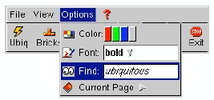
This paper presents a new GUI architecture for creating advanced interfaces. This model is based on a limited set of general principles that improve flexibility and provide capabilities for implementing information visualization techniques such as magic lenses, transparent tools or semantic zooming. This architecture also makes it possible to create multiple views and application-sharing systems (by sharing views on multiple computer screens) in a simple and uniform way and to handle bimanual interaction and multiple pointers. An experimental toolkit called Ubit was implemented to test the feasibility of this approach. It is based on a pseudo-declarative C++ API that tries to simplify GUI programming by providing a higher level of abstraction.

In Proceedings of UIST 2004
Article Picture

The MaggLite post-WIMP toolkit: draw it, connect it and run it (p. 257-266)

Abstract plus

This article presents MaggLite, a toolkit and sketch-based interface builder allowing fast and interactive design of post-WIMP user interfaces. MaggLite improves design of advanced UIs thanks to its novel mixed-graph architecture that dynamically combines scene-graphs with interaction-graphs. Scene-graphs provide mechanisms to describe and produce rich graphical effects, whereas interaction-graphs allow expressive and fine-grained description of advanced interaction techniques and behaviors such as multiple pointers management, toolglasses, bimanual interaction, gesture, and speech recognition. Both graphs can be built interactively by sketching the UI and specifying the interaction using a dataflow visual language. Communication between the two graphs is managed at runtime by components we call Interaction Access Points. While developers can extend the toolkit by refining built-in generic mechanisms, UI designers can quickly and interactively design, prototype and test advanced user interfaces by applying the MaggLite principle: "draw it, connect it and run it".

information architecture

In Proceedings of UIST 2001
Article Picture

The designers' outpost: a tangible interface for collaborative web site (p. 1-10)

Abstract plus

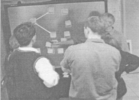
In our previous studies into web design, we found that pens, paper, walls, and tables were often used for explaining, developing, and communicating ideas during the early phases of design. These wall-scale paper-based design practices inspired The Designers' Outpost, a tangible user interface that combines the affordances of paper and large physical workspaces with the advantages of electronic media to support information design. With Outpost, users collaboratively author web site information architectures on an electronic whiteboard using physical media (Post-it notes and images), structuring and annotating that information with electronic pens. This interaction is enabled by a touch-sensitive SMART Board augmented with a robust computer vision system, employing a rear-mounted video camera for capturing movement and a front-mounted high-resolution camera for capturing ink. We conducted a participatory design study with fifteen professional web designers. The study validated that Outpost supports information architecture work practice, and led to our adding support for fluid transitions to other tools.

model-driven architecture

In Proceedings of UIST 2004
Article Picture

Revisiting visual interface programming: creating GUI tools for designers and programmers (p. 267-276)

Abstract plus

Involving graphic designers in the large-scale development of user interfaces requires tools that provide more graphical flexibility and support efficient software processes. These requirements were analysed and used in the design of the TkZ-inc graphical library and the IntuiKit interface design environment. More flexibility is obtained through a wider palette of visual techniques and support for iterative construction of images, composition and parametric displays. More efficient processes are obtained with the use of the SVG standard to import graphics, support for linking graphics and behaviour, and a unifying model-driven architecture. We describe the corresponding features of our tools, and show their use in the development of an application for airports. Benefits include a wider access to high quality visual interfaces for specialised applications, and shorter prototyping and development cycles for multidisciplinary teams.

multimodal architecture

In Proceedings of UIST 2000
Article Picture

Multimodal system processing in mobile environments (p. 21-30)

negotiation architecture

In Proceedings of UIST 1998
Article Picture

A negotiation architecture for fluid documents (p. 123-132)

software architecture

In Proceedings of UIST 2004
Article Picture

Revisiting visual interface programming: creating GUI tools for designers and programmers (p. 267-276)

Abstract plus

Involving graphic designers in the large-scale development of user interfaces requires tools that provide more graphical flexibility and support efficient software processes. These requirements were analysed and used in the design of the TkZ-inc graphical library and the IntuiKit interface design environment. More flexibility is obtained through a wider palette of visual techniques and support for iterative construction of images, composition and parametric displays. More efficient processes are obtained with the use of the SVG standard to import graphics, support for linking graphics and behaviour, and a unifying model-driven architecture. We describe the corresponding features of our tools, and show their use in the development of an application for airports. Benefits include a wider access to high quality visual interfaces for specialised applications, and shorter prototyping and development cycles for multidisciplinary teams.

task-driven design of architecture

In Proceedings of UIST 1995
Article Picture

Automatic generation of task-oriented help (p. 181-187)