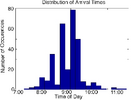
People use their awareness of others' temporal patterns to plan work activities and communication. This paper presents algorithms for programatically detecting and modeling temporal patterns from a record of online presence data. We describe analytic and end-user visualizations of rhythmic patterns and the tradeoffs between them. We conducted a design study that explored the accuracy of the derived rhythm models compared to user perceptions, user preference among the visualization alternatives, and users' privacy preferences. We also present a prototype application based on the rhythm model that detects when a person is "away" for an extended period and predicts their return. We discuss the implications of this technology on the design of computer-mediated communication.

IVR (interactive voice response) menu navigation has long been recognized as a frustrating interaction experience. We propose an IM-based system that sends a coordinated visual IVR menu to the caller's computer screen. The visual menu is updated in real time in response to the caller's actions. With this automatically opened supplementary channel, callers can take advantages of different modalities over different devices and interact with the IVR system with the ease of graphical menu selection. Our approach of utilizing existing network infrastructure to pinpoint the caller's virtual location and coordinating multiple devices and multiple channels based on users' ID registration can also be more generally applied to create integrated user experiences across a group of devices.

A system that uses an ear proximity sensor to actively manage periods of distraction during telephone conversations is described. We detect when the phone is removed from the ear, record any incoming audio, and play it back when the phone is returned to the ear. By dropping silent intervals and speeding up playback with a pitch-preserving algorithm, we quickly return to real-time without the loss of information. This real-time audio buffering technique also allows us to create a user-activated, lossless instant replay function.