Keywords
UIST2.0 Archive - 20 years of UIST
Back
Back to keywords index

intelligent

intelligent diagram

In Proceedings of UIST 1998
Article Picture

Automatic construction of intelligent diagram editors (p. 185-194)

intelligent multimedia interface

In Proceedings of UIST 2004
Article Picture

An optimization-based approach to dynamic data content selection in intelligent multimedia interfaces (p. 227-236)

Abstract plus

We are building a multimedia conversation system to facilitate information seeking in large and complex data spaces. To provide tailored responses to diverse user queries introduced during a conversation, we automate the generation of a system response. Here we focus on the problem of determining the data content of a response. Specifically, we develop an optimization-based approach to content selection. Compared to existing rule-based or plan-based approaches, our work offers three unique contributions. First, our approach provides a general framework that effectively addresses content selection for various interaction situations by balancing a comprehensive set of constraints (e.g., content quality and quantity constraints). Second, our method is easily extensible, since it uses feature-based metrics to systematically model selection constraints. Third, our method improves selection results by incorporating content organization and media allocation effects, which otherwise are treated separately. Preliminary studies show that our method can handle most of the user situations identified in a Wizard-of-Oz study, and achieves results similar to those produced by human designers.

intelligent office

In Proceedings of UIST 2004
Article Picture

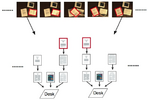
Video-based document tracking: unifying your physical and electronic desktops (p. 99-107)

Abstract plus

This paper presents an approach for tracking paper documents on the desk over time and automatically linking them to the corresponding electronic documents using an overhead video camera. We demonstrate our system in the context of two scenarios, paper tracking and photo sorting. In the paper tracking scenario, the system tracks changes in the stacks of printed documents and books on the desk and builds a complete representation of the spatial structure of the desktop. When users want to find a printed document buried in the stacks, they can query the system based on appearance, keywords, or access time. The system also provides a remote desktop interface for directly browsing the physical desktop from a remote location. In the photo sorting scenario, users sort printed photographs into physical stacks on the desk. The systemautomatically recognizes the photographs and organizes the corresponding digital photographs into separate folders according to the physical arrangement. Our framework provides a way to unify the physical and electronic desktops without the need for a specialized physical infrastructure except for a video camera.

intelligent ui

In Proceedings of UIST 2004
Article Picture

SketchREAD: a multi-domain sketch recognition engine (p. 23-32)

Abstract plus

We present SketchREAD, a multi-domain sketch recognition engine capable of recognizing freely hand-drawn diagrammatic sketches. Current computer sketch recognition systems are difficult to construct, and either are fragile or accomplish robustness by severely limiting the designer's drawing freedom. Our system can be applied to a variety of domains by providing structural descriptions of the shapes in that domain; no training data or programming is necessary. Robustness to the ambiguity and uncertainty inherent in complex, freely-drawn sketches is achieved through the use of context. The system uses context to guide the search for possible interpretations and uses a novel form of dynamically constructed Bayesian networks to evaluate these interpretations. This process allows the system to recover from low-level recognition errors (e.g., a line misclassified as an arc) that would otherwise result in domain level recognition errors. We evaluated Sketch-READ on real sketches in two domains--family trees and circuit diagrams--and found that in both domains the use of context to reclassify low-level shapes significantly reduced recognition error over a baseline system that did not reinterpret low-level classifications. We also discuss the system's potential role in sketch based user interfaces.

intelligent user interface

In Proceedings of UIST 2001
Article Picture

Outlier finding: focusing user attention on possible errors (p. 81-90)

Abstract plus

When users handle large amounts of data, errors are hard to notice. Outlier finding is a new way to reduce errors by directing the user's attention to inconsistent data which may indicate errors. We have implemented an outlier finder for text, which can detect both unusual matches and unusual mismatches to a text pattern. When integrated into the user interface of a PBD text editor and tested in a user study, outlier finding substantially reduced errors.

In Proceedings of UIST 2004
Article Picture

Citrine: providing intelligent copy-and-paste (p. 185-188)

Abstract plus

We present Citrine, a system that extends the widespread copy-and-paste interaction technique with intelligent transformations, making it useful in more situations. Citrine uses text parsing to find the structure in copied text and allows users to paste the structured information, which might have many pieces, in a single paste operation. For example, using Citrine, a user can copy the text of a meeting request and add it to the Outlook calendar with a single paste. In applications such as Excel, users can teach Citrine by example how to copy and paste data by showing it which fields go into which columns, and can use this to copy or paste many items at a time in a user-defined manner. Citrine can be used with a wide variety of applications and types of data and can be easily extended to work with more. It currently includes parsers that recognize contact information, calendar appointments and bibliographic citations. It works with Internet Explorer, Outlook, Excel, Palm Desktop, EndNote and other applications. Citrine is available to download on the internet.