Most document or information management systems rely on hierarchies to organise documents (e.g. files, email messages or web bookmarks). However, the rigid structures of hierarchical schemes do not mesh well with the more fluid nature of everyday document practices. This paper describes Presto, a prototype system that allows users to organise their documents entirely in terms of the properties those documents hold for users. Properties provide a uniform mechanism for managing, coding, searching, retrieving and interacting with documents. We concentrate in particular on the challenges that property-based approaches present and the architecture we have developed to tackle them.

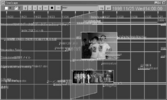
This paper describes the concept of Time-Machine Computing (TMC), a time-centric approach to organizing information on computers. A system based on Time-Machine Computing allows a user to visit the past and the future states of computers. When a user needs to refer to a document that he/she was working on at some other time, he/she can travel in the time dimension and the system restores the computer state at that time. Since the user's activities on the system are automatically archived, the user's daily workspace is seamlessly integrated into the information archive. The combination of spatial information management of the desktop metaphor and time traveling allows a user to organize and archive information without being bothered by folder hierarchies or the file classification problems that are common in today's desktop environments. TMC also provides a mechanism for linking multiple applications and external information sources by exchanging time information. This paper describes the key features of TMC, a time-machine desktop environment called “TimeScape,” and several time-oriented application integration examples.

Most document or information management systems rely on hierarchies to organise documents (e.g. files, email messages or web bookmarks). However, the rigid structures of hierarchical schemes do not mesh well with the more fluid nature of everyday document practices. This paper describes Presto, a prototype system that allows users to organise their documents entirely in terms of the properties those documents hold for users. Properties provide a uniform mechanism for managing, coding, searching, retrieving and interacting with documents. We concentrate in particular on the challenges that property-based approaches present and the architecture we have developed to tackle them.

Most document or information management systems rely on hierarchies to organise documents (e.g. files, email messages or web bookmarks). However, the rigid structures of hierarchical schemes do not mesh well with the more fluid nature of everyday document practices. This paper describes Presto, a prototype system that allows users to organise their documents entirely in terms of the properties those documents hold for users. Properties provide a uniform mechanism for managing, coding, searching, retrieving and interacting with documents. We concentrate in particular on the challenges that property-based approaches present and the architecture we have developed to tackle them.

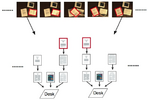
This paper presents an approach for tracking paper documents on the desk over time and automatically linking them to the corresponding electronic documents using an overhead video camera. We demonstrate our system in the context of two scenarios, paper tracking and photo sorting. In the paper tracking scenario, the system tracks changes in the stacks of printed documents and books on the desk and builds a complete representation of the spatial structure of the desktop. When users want to find a printed document buried in the stacks, they can query the system based on appearance, keywords, or access time. The system also provides a remote desktop interface for directly browsing the physical desktop from a remote location. In the photo sorting scenario, users sort printed photographs into physical stacks on the desk. The systemautomatically recognizes the photographs and organizes the corresponding digital photographs into separate folders according to the physical arrangement. Our framework provides a way to unify the physical and electronic desktops without the need for a specialized physical infrastructure except for a video camera.

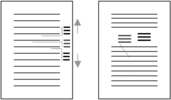
Freeform digital ink annotation allows readers to interact with documents in an intuitive and familiar manner. Such marks are easy to manage on static documents, and provide a familiar annotation experience. In this paper, we describe an implementation of a freeform annotation system that accommodates dynamic document layout. The algorithm preserves the correct position of annotations when documents are viewed with different fonts or font sizes, with different aspect ratios, or on different devices. We explore a range of heuristics and algorithms required to handle common types of annotation, and conclude with a discussion of possible extensions to handle special kinds of annotations and changes to documents.

Paper Augmented Digital Documents (PADDs) are digital documents that can be manipulated either on a computer screen or on paper. PADDs, and the infrastructure supporting them, can be seen as a bridge between the digital and the paper worlds. As digital documents, PADDs are easy to edit, distribute and archive; as paper documents, PADDs are easy to navigate, annotate and well accepted in social settings. The chimeric nature of PADDs make them well suited for many tasks such as proofreading, editing, and annotation of large format document like blueprints.We are presenting an architecture which supports the seamless manipulation of PADDs using today's technologies and reports on the lessons we learned while implementing the first PADD system.

This paper presents a novel image editing program emphasizing easy selection and manipulation of material found in informal, casual documents such as sketches, handwritten notes, whiteboard images, screen snapshots, and scanned documents. The program, called ScanScribe, offers four significant advances. First, it presents a new, intuitive model for maintaining image objects and groups, along with underlying logic for updating these in the course of an editing session. Second, ScanScribe takes advantage of newly developed image processing algorithms to separate foreground markings from a white or light background, and thus can automatically render the background transparent so that image material can be rearranged without occlusion by background pixels. Third, ScanScribe introduces new interface techniques for selecting image objects with a pointing device without resorting to a palette of tool modes. Fourth, ScanScribe presents a platform for exploiting image analysis and recognition methods to make perceptually significant structure readily available to the user. As a research prototype, ScanScribe has proven useful in the work of members of our laboratory, and has been released on a limited basis for user testing and evaluation.

This paper presents a novel image editing program emphasizing easy selection and manipulation of material found in informal, casual documents such as sketches, handwritten notes, whiteboard images, screen snapshots, and scanned documents. The program, called ScanScribe, offers four significant advances. First, it presents a new, intuitive model for maintaining image objects and groups, along with underlying logic for updating these in the course of an editing session. Second, ScanScribe takes advantage of newly developed image processing algorithms to separate foreground markings from a white or light background, and thus can automatically render the background transparent so that image material can be rearranged without occlusion by background pixels. Third, ScanScribe introduces new interface techniques for selecting image objects with a pointing device without resorting to a palette of tool modes. Fourth, ScanScribe presents a platform for exploiting image analysis and recognition methods to make perceptually significant structure readily available to the user. As a research prototype, ScanScribe has proven useful in the work of members of our laboratory, and has been released on a limited basis for user testing and evaluation.