This paper presents a demonstrational interface builder with improved reasoning capabilities. The system is comprised of two major components: an interactive display manager and a rule-based reasoner. The display manager provides facilities to draw the physical appearance of an interface and define interface behavior by graphical demonstration. The behavior is defined using a technique of stimulus-response demonstrations. With this technique, an interface developer first demonstrates a stimulus that represents an action that an end user will perform on the interface. After the stimulus, the developer demonstrates the response(s) that should result from the given stimulus. As the behavior is demonstrated, the reasoner observes the demonstrations and draws inferences to expedite behavior definition. The inferences entail generalizing from specific behavior demonstrations and identifying constraints that define the generalized behavior. Once behavior constraints are identified, the reasoner sends them to the display manager to complete the definition process. When the interface is executed by an end-user, the display manager uses the constraints to implement the run-time behavior of the interface.

We present an inference engine that can be used for creating Programming By Demonstration systems. The class of systems addressed are those which infer a state change description from examples of state [9, 11].
The engine can easily be incorporated into an existing design environment that provides an interactive object editor.
The main design goals of the inference engine are responsiveness and generality. All demonstrational systems must respond quickly because of their interactive use. They should also be general---they should be able to make inferences for any attribute that the user may want to define by demonstration, and they should be able to treat any other attributes as parameters of this definition.
The first goal, responsiveness, is best accommodated by limiting the number of attributes that the inference engine takes into consideration. This, however, is in obvious conflict with the second goal, generality.
This conflict is intrinsic to the class of demonstrational system described above. The challenge is to find an algorithm which responds quickly but does not heuristically limit the number of attributes it looks at. We present such an algorithm in this paper.
A companion paper describes Inference Bear [4], an actual demonstrational system that we have built using this inference engine and an existing user interface builder [5].

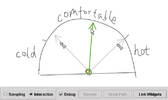
Informal prototyping tools have shown great potential in facilitating the early stage design of user interfaces. How-ever, continuous interactions, an important constituent of highly interactive interfaces, have not been well supported by previous tools. These interactions give continuous visual feedback, such as geometric changes of a graphical object, in response to continuous user input, such as the movement of a mouse. We built Monet, a sketch-based tool for proto-typing continuous interactions by demonstration. In Monet, designers can prototype continuous widgets and their states of interest using examples. They can also demonstrate com-pound behaviors involving multiple widgets by direct ma-nipulation. Monet allows continuous interactions to be eas-ily integrated with event-based, discrete interactions. Con-tinuous widgets can be embedded into storyboards and their states can condition or trigger storyboard transitions. Monet achieves these features by employing continuous function approximation and statistical classification techniques, without using any domain specific knowledge or assuming any application semantics. Informal feedback showed that Monet is a promising approach to enabling more complete tool support for early stage UI design.