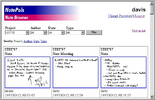

ScreenCrayons is a system for collecting annotations on any type of document or visual information from any application. The basis for the system is a screen capture upon which the user can highlight the relevant portions of the image. The user can define any number of topics for organizing notes. Each topic is associated with a highlighting "crayon." In addition the user can supply annotations in digital ink or text. Algorithms are described that summarize captured images based on the highlight strokes so as to provide overviews of many annotations as well as being able to "zoom in" on particular information about a given note and the context of that note.

Paper Augmented Digital Documents (PADDs) are digital documents that can be manipulated either on a computer screen or on paper. PADDs, and the infrastructure supporting them, can be seen as a bridge between the digital and the paper worlds. As digital documents, PADDs are easy to edit, distribute and archive; as paper documents, PADDs are easy to navigate, annotate and well accepted in social settings. The chimeric nature of PADDs make them well suited for many tasks such as proofreading, editing, and annotation of large format document like blueprints.We are presenting an architecture which supports the seamless manipulation of PADDs using today's technologies and reports on the lessons we learned while implementing the first PADD system.

Freeform digital ink annotation allows readers to interact with documents in an intuitive and familiar manner. Such marks are easy to manage on static documents, and provide a familiar annotation experience. In this paper, we describe an implementation of a freeform annotation system that accommodates dynamic document layout. The algorithm preserves the correct position of annotations when documents are viewed with different fonts or font sizes, with different aspect ratios, or on different devices. We explore a range of heuristics and algorithms required to handle common types of annotation, and conclude with a discussion of possible extensions to handle special kinds of annotations and changes to documents.

Prototyping is the pivotal activity that structures innovation, collaboration, and creativity in design. Prototypes embody design hypotheses and enable designers to test them. Framin design as a thinking-by-doing activity foregrounds iteration as a central concern. This paper presents d.tools, a toolkit that embodies an iterative-design-centered approach to prototyping information appliances. This work offers contributions in three areas. First, d.tools introduces a statechart-based visual design tool that provides a low threshold for early-stage prototyping, extensible through code for higher-fidelity prototypes. Second, our research introduces three important types of hardware extensibility - at the hardware-to-PC interface, the intra-hardware communication level, and the circuit level. Third, d.tools integrates design, test, and analysis of information appliances. We have evaluated d.tools through three studies: a laboratory study with thirteen participants; rebuilding prototypes of existing and emerging devices; and by observing seven student teams who built prototypes with d.tools.

Paper Augmented Digital Documents (PADDs) are digital documents that can be manipulated either on a computer screen or on paper. PADDs, and the infrastructure supporting them, can be seen as a bridge between the digital and the paper worlds. As digital documents, PADDs are easy to edit, distribute and archive; as paper documents, PADDs are easy to navigate, annotate and well accepted in social settings. The chimeric nature of PADDs make them well suited for many tasks such as proofreading, editing, and annotation of large format document like blueprints.We are presenting an architecture which supports the seamless manipulation of PADDs using today's technologies and reports on the lessons we learned while implementing the first PADD system.

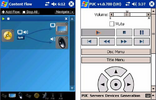
Systems of connected appliances, such as home theaters and presentation rooms, are becoming commonplace in our homes and workplaces. These systems are often difficult to use, in part because users must determine how to split the tasks they wish to perform into sub-tasks for each appliance and then find the particular functions of each appliance to complete their sub-tasks. This paper describes Huddle, a new system that automatically generates task-based interfaces for a system of multiple appliances based on models of the content flow within the multi-appliance system.

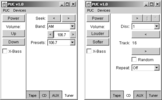
The personal universal controller (PUC) is an approach for improving the interfaces to complex appliances by introducing an intermediary graphical or speech interface. A PUC engages in two-way communication with everyday appliances, first downloading a specification of the appliance's functions, and then automatically creating an interface for controlling that appliance. The specification of each appliance includes a high-level description of every function, a hierarchical grouping of those functions, and dependency information, which relates the availability of each function to the appliance's state. Dependency information makes it easier for designers to create specifications and helps the automatic interface generators produce a higher quality result. We describe the architecture that supports the PUC, and the interface generators that use our specification language to build high-quality graphical and speech interfaces.