Keywords
UIST2.0 Archive - 20 years of UIST
Back
Back to keywords index

geometric

geometric constraint

In Proceedings of UIST 2001
Article Picture

A modular geometric constraint solver for user interface applications (p. 91-100)

Abstract plus

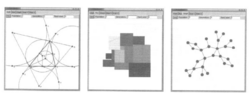
Constraints have been playing an important role in the user interface field since its infancy. A prime use of constraints in this field is to automatically maintain geometric layouts of graphical objects. To facilitate the construction of constraint-based user interface applications, researchers have proposed various constraint satisfaction methods and constraint solvers. Most previous research has focused on either local propagation or linear constraints, excluding more general nonlinear ones. However, nonlinear geometric constraints are practically useful to various user interfaces, e.g., drawing editors and information visualization systems. In this paper, we propose a novel constraint solver called Chorus, which realizes various powerful nonlinear geometric constraints such as Euclidean geometric, non-overlapping, and graph layout constraints. A key feature of Chorus is its module mechanism that allows users to define new kinds of geometric constraints. Also, Chorus supports "soft" constraints with hierarchical strengths or preferences (i.e., constraint hierarchies). We describe its framework, algorithm, implementation, and experimental results.

geometric modeling

In Proceedings of UIST 1994
Article Picture

Two-handed polygonal surface design (p. 205-212)

Abstract plus

This paper describes a Computer Aided Design system for sketching free-form polygonal surfaces such as terrains and other natural objects. The user manipulates two 3D position and orientation trackers with three buttons, one for each hand. Each hand has a distinct role to play, with the dominant hand being responsible for picking and manipulation, and the less-dominant hand being responsible for context setting of various kinds. The less-dominant hand holds the workpiece, sets which refinement level that can be picked by the dominant hand, and generally acts as a counterpoint to the dominant hand. In this paper, the architecture of the system is outlined, and a simple surface is shown.

In Proceedings of UIST 2000
Article Picture

Dynamic space management for user interfaces (p. 239-248)

In Proceedings of UIST 2001
Article Picture

Simplicial families of drawings (p. 163-172)

Abstract plus

In this paper we present a method for helping artists make artwork more accessible to casual users. We focus on the specific case of drawings, showing how a small number of drawings can be transformed into a richer object containing an entire family of similar drawings. This object is represented as a simplicial complex approximating a set of valid interpolations in configuration space. The artist does not interact directly with the simplicial complex. Instead, she guides its construction by answering a specially chosen set of yes/no questions. By combining the flexibility of a simplicial complex with direct human guidance, we are able to represent very general constraints on membership in a family. The constructed simplicial complex supports a variety of algorithms useful to an end user, including random sampling of the space of drawings, constrained interpolation between drawings, projection of another drawing into the family, and interactive exploration of the family.