

About ACM
ACM, the world's largest educational and scientific computing society, delivers resources that advance computing as a science and a profession. ACM provides the computing field's premier Digital Library and serves its members and the computing profession with leading-edge publications, conferences, and career resources.
Get Involved with ACM
ACM is a volunteer-led and member-driven organization. Everything ACM accomplishes is through the efforts of people like you. A wide range of activities keeps ACM moving: organizing conferences, editing journals, reviewing papers and participating on boards and committees, to name a few. Find out all the ways that you can volunteer with ACM.
ACM Chapters
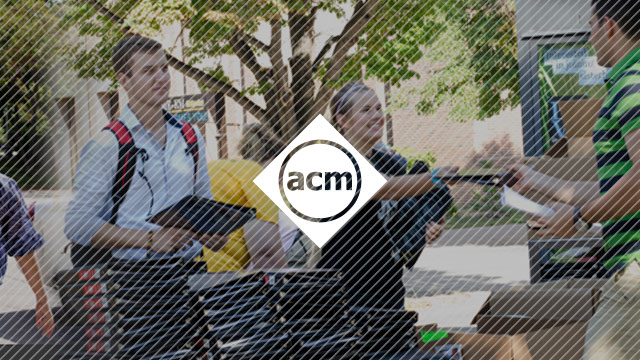
Chapters are the "local neighborhoods" of ACM. Professional and Student chapters worldwide serve as nodes of activity for ACM members and the computing community at large, offering seminars, lectures, and the opportunity to meet peers and experts in many fields of interest.

ACM: Formed at the Dawn of Computing
ACM was established in 1947 soon after the creation of ENIAC, the first stored-program digital computer, to “advance the science, development, construction, and application of the new machinery for computing, reasoning, and other handling of information.”

ACM-W
ACM-W supports, celebrates, and advocates internationally for the full engagement of women in all aspects of computing, providing a wide range of programs and services to ACM members and working in the larger community to advance the contributions of technical women. Membership in ACM-W is open to all ACM members and is free of charge.

Guiding Members with a Framework of Ethical Conduct
Learn more about ACM’s commitment to ethical standards: the ACM Code of Ethics, Software Engineering Code of Ethics and Professional Practice, and Committee on Professional Ethics (COPE), which is guiding these and other intiatives.
ACM Regional Councils
ACM's Regional Councils provide grassroots support on a global scale. Based in Europe, India, and China, they raise awareness, visibility and relevance of ACM by sponsoring high-quality conferences, expanding chapters, and encouraging greater participation in all dimensions of the society.

ACM’s Volunteer Leaders
ACM is a volunteer-driven organization. Our volunteer leaders choose the directions for ACM and oversee our many activities and initiatives.
- ACM’s elected officers have overall responsibility for ACM. [Learn more...]
- ACM Council members function as our board of directors. [Learn more...]
- ACM’s Board and Council Chairs are responsible for particular types of services and initiatives. [Learn more...]
- ACM’s Special Interest Group Governing Board oversees the activities of the interest groups that manage most of our conferences and special projects. [Learn more...]
- ACM Regional Council Leaders oversee our activities in other parts of the globe. [Learn more...]
Shape the Future of Computing!
For over 70 years, ACM has helped computing professionals to be their most creative, connect to peers, and see what’s next. Joining ACM means you dare to be the best computing professional you can be.
Be Creative. Stay connected. Keep inventing.
Become an Ambassador for ACM
Encourage your colleagues to join ACM, share the benefits of ACM and receive free gifts for participating. Your support of ACM is critical to our continuing efforts to advance computing as a science and a profession.
ACM Code of Ethics
The ACM Code of Ethics and Professional Conduct was updated in 2018 to address the significant advances in computing technology since the 1992 version, as well as the growing pervasiveness of computing in all aspects of society.